KDP automation risk
The hard part was not making books. It was surviving the pipeline.
Automation made publishing faster. It also made mistakes travel farther before a human noticed. These are the public, redacted failure modes from the operation.
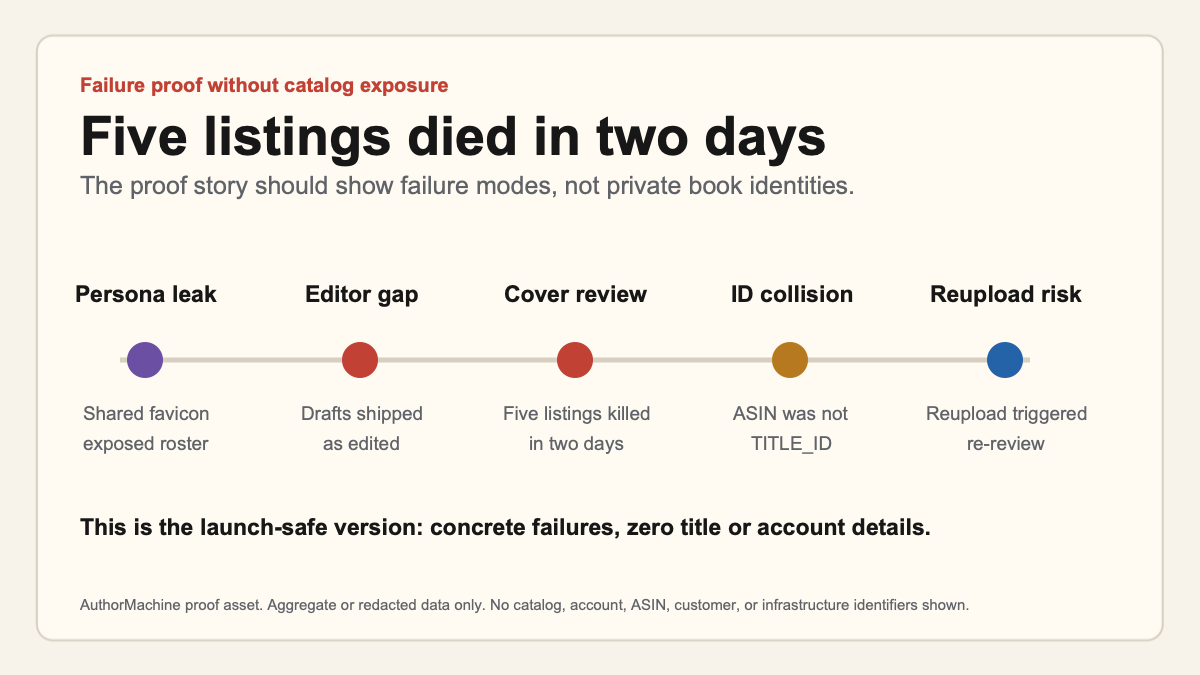
The failures that changed the rules
The course is built around concrete failures: a persona leak caused by a shared favicon, a writing pipeline that claimed editing had happened when it had not, cover review that killed five listings in two days, an ASIN/title-ID collision, and reuploads that triggered new review risk.
Those are not edge cases. They are what happens when a publishing workflow becomes a system. Small assumptions become repeatable defects.
What serious automation needs
- Manifest validation before upload.
- Separate identity assets for every pen name.
- Human reading as the final quality gate.
- Duplicate-title checks against the real live catalog.
- Pre-reupload audits before touching selling books.
- Failure logs that survive cleanup.
The operating kit exists because careful human attention was not enough at catalog scale. The tools are named after the failures they prevent.
Related public pages
Start with the real numbers
Module 0 is free and ungated. It shows the revenue, the median title, the cost structure, and why this is not a passive-income pitch.